How to read buy and sell signals for stocks
A buy or sell signal is the output of a rule. Something about a stock’s price, or its numbers, crossed a line the rule cares about, and the rule flags it. Read that way, a signal is a prompt to take a closer look, not a prediction of what the price will do next.
Where buy and sell signals come from
Most signals come from technical rules applied to daily prices: a price closing above a moving average, two moving averages crossing, a breakout above a recent high, or an indicator such as RSI or MACD passing a threshold. Some tools also add fundamental checks, such as valuation or debt, to rank the signals they produce.
The upside of a rule is consistency: the same price history always gives the same answer, with no fear or excitement involved. The downside is that a rule only sees what it measures. It doesn’t read the news, and it can’t know that an earnings report is out tomorrow.
How to read a signal, step by step
- Know the rule behind it. Trend-following signals, the most common kind, fire after a move has already started. They will be late at turning points and can flip back and forth when a stock moves sideways.
- Check its age. A BUY that appeared yesterday and one that appeared two months ago, after a big run, are different situations, even though both say BUY.
- Check how strong it is. If the tool gives a score or a ranking, use it to compare signals instead of treating every BUY as equal.
- Look at the context. Is the stock’s sector moving the same way? Is the market calm or nervous? Is an earnings report due soon?
- Decide your size and your exit first. Before acting, decide how much of your money goes into one position and what would make you sell.
Common mistakes
- Treating a signal as a guarantee. Every signal system is wrong some of the time.
- Acting on a signal long after it appeared, without checking how far the price has moved.
- Putting most of your money into a single signal.
- Ignoring a SELL on a stock you own because you like the company.
How Laftel Trade’s signals work
Laftel Trade gives a daily signal to the stocks in the S&P 500 and the Nasdaq 100, minus the companies it excludes (defense and weapons, fossil fuels, tobacco, and human rights or labor violations). The signal is trend-following, and the rule is public here:
- BUY after two daily closes in a row above two trend lines: an adaptive moving average, which speeds up when the price moves steadily one way and slows down when it chops around, and a second line halfway between that average and the middle of the stock’s 30-day range.
- SELL after two daily closes in a row below both lines. A SELL means sell or avoid; Trade doesn’t suggest shorting.
- HOLD when the closes are mixed, or when a BUY’s 10% trailing stop is hit: the price falls 10% or more below its highest close since the BUY. After leaving a BUY or SELL for HOLD, that same signal can’t return for 7 days.
Signals are set after each market close. The Changed column on the Dashboard shows how long ago each one appeared.
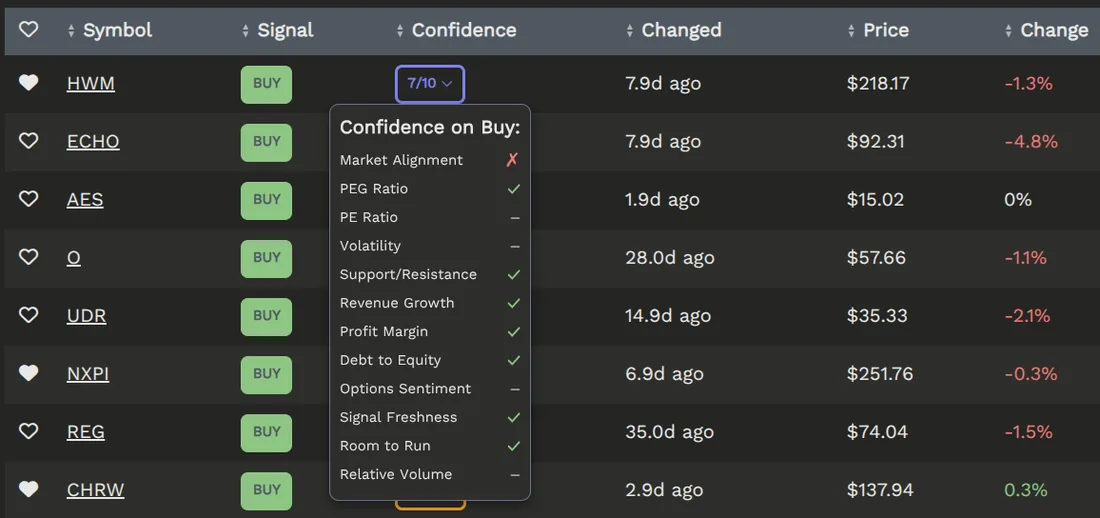
Each BUY or SELL also gets a confidence score from 0 to 10, built from 12 equally weighted factors: room to run, market and VIX, PEG ratio, PE ratio, volatility, support and resistance, options sentiment, signal freshness, relative volume, revenue growth, profit margin and debt to equity. Valuation factors compare a stock with similar companies in its industry or sector. Read 7 or more as high, 5–6 as moderate, and below 5 as low. Premium members can open a score to see which factors pass (✓) or fail (✗).
During the trading day, if the live price says a signal is likely to flip at the close, its confidence shows 0 until the daily update. That is a cue to wait for the close.
Signals, confidence scores and the Dashboard are free. When you’re ready, our guide to knowing when to sell a stock covers the other half of the trade.
Not financial advice. This guide is general education, not a recommendation to buy or sell any security. Investing involves risk, including the loss of money you invest, and past results don’t guarantee future results. See our Terms and Conditions.